

Evaluate examples through the buyer’s task
Export marketing for manufacturers connects your offer with target-market questions. Visitors may need to select a product, verify capabilities, find documentation or request a quote. Look at how an example separates those tasks. Copying a homepage image cannot replace your product data or sales process.
This review is limited to public content and navigation information. It does not claim speed, accessibility, security or conversion testing. Color harmony, restrained layouts, large type, facility images and animation from the original selection remain useful design questions; do not assume every historical visual treatment remains unchanged today.
Product suitability
Do product families, applications and technical details support the buyer’s initial screening?
Capability evidence
Which claims are supported by processes, equipment, real projects or applicable valid documents?
Next step
Can a technical question, quotation request or service inquiry reach the right team clearly?
Processes and services: CLY-DEL, Weldrite, Hargrove and Magellan Power
Corporate website planning helps separate company information from service descriptions. These examples offer process, capability and application pathways. Use a concise overview with deeper pages for relevant detail; numerous services need meaningful groups rather than one long paragraph.
CLY-DEL and Hargrove expose service or capability routes. Magellan Power includes case studies and brochures in its resources. Weldrite’s official search content shows products, services and industries, but direct retrieval failed during this research. It remains an example without a definitive claim about current visual or interaction quality.
CLY-DEL
<a href="https://cly-del.com/">CLY-DEL</a> separates metalforming services from capabilities such as engineering and prototyping. Consider how process names connect with the buyer’s application.
Weldrite
<a href="https://weldriteltd.com/">Weldrite</a> represents metal-handling products and welding/fabrication services. Examine how product and industry routes can remain understandable as information grows.
Hargrove
<a href="https://hargrove-epc.com/">Hargrove</a> categorizes EPC, engineering and project capabilities. A service name needs scope and an explanation of the requirement it addresses.
Magellan Power
<a href="https://magellanpower.com.au/">Magellan Power</a> connects power systems with technical resources. Present case studies through a problem and solution, as well as imagery.
FROM READING TO A NEXT STEP
Define your manufacturing website scope
Share product families, target markets and technical quotation needs so we can assess the content structure and initial launch scope.
Catalogs and resources: six different examples
CMS selection matters alongside category and document management. P. Kay Metal, Plex, Hallsten, TexTech, TYMETAL and Polymer are different business types. Those differences determine which structures are relevant to your project. Examine connections between products, applications and technical resources.
A black/green palette, side navigation or animated transitions cannot solve a buyer task alone. Images should explain the product; menus need mobile and keyboard usability; long material needs scannable headings. Do not conclude that content is effortless to use without testing relevant tasks with your users.
P. Kay Metal
<a href="https://www.pkaymetal.com/">P. Kay Metal</a> presents solder products, metal processing and recycling. Explore how product and process information can keep material context clear.
Plex
<a href="https://www.plex.com/">Plex</a> supplies manufacturing software, rather than a factory product catalog. Official search content describes MES capabilities and resources; direct retrieval failed, so no current navigation test is claimed.
Hallsten
<a href="https://hallsten.com/">Hallsten</a> separates environmental, marine and industrial products. Connect production or project images with product, technical and sales-representative information.
TexTech
<a href="https://textechindustries.com/">TexTech</a> separates industries, capabilities, products and resources. Related content can support a large catalog without repeating every detail.
TYMETAL
<a href="https://www.tymetal.com/">TYMETAL</a> offers gate/barrier categories and drawing/specification routes. It illustrates a transition from technical evaluation toward a project inquiry.
Polymer Workshop
<a href="https://www.polymer.ws/">Polymer Workshop</a> presents high-performance bicycle components. It can inform product presentation; it is not a direct equivalent of a complex industrial quotation process.
Başaranlar Proses and Cheminox: technical subjects need specific explanations
Başaranlar Proses and Cheminox appear among Prix Studio’s project examples and explain different technical subjects. About-page planning connects company information with capabilities and working methods. Explore product organization, services and explanatory content without attributing sales or production outcomes to design alone.
Başaranlar Proses offers separate routes for heat exchangers and process equipment. Consistent material and technical information can support product comparison. Have technical teams verify specifications and documents; translated text needs meaningful terminology and completed fields.
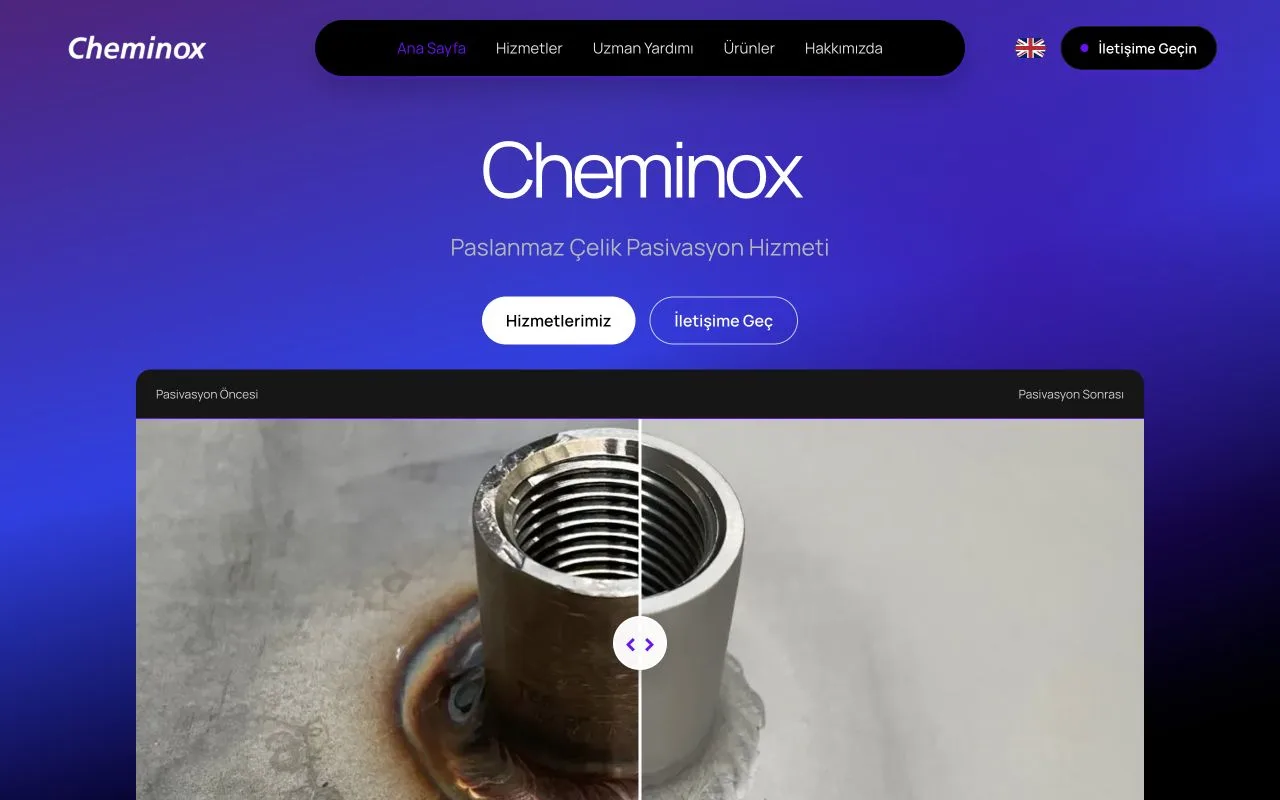
Cheminox explains stainless-steel passivation through service types and educational articles. A brief definition, application context and service page can complement one another. Plan the question the page answers alongside colors and opening-screen transitions.
Product structure
Manage families, properties, applications and technical inquiries through a consistent information model.
Service structure
Explain methods, application locations, scope and information needed for an initial assessment.
Plan design, content and upkeep together
Corporate site scope connects design and maintenance requirements. Logos, colors and quality images can support consistency; readability and access need separate evaluation. Use real production and project images. Publish testimonials or documents only when verified and permitted.
Write concrete acceptance criteria for mobile tasks, loading, security and updates. Specify which information technical, marketing and sales teams maintain. Social links can provide another channel; they do not replace answering technical questions on the site.
| Area | Decision to plan |
|---|---|
| UI/UX, logo and color | Readable headings, consistent identity and usable menus |
| Mobile use and speed | Real device tasks, image sizes and measured loading |
| Security and communication | Access roles, maintenance, form protection and routing |
| CMS and imagery | Product templates, content owners and permitted media |
| SEO and blog | Clear titles, descriptions, discoverable pages and useful technical writing |
| References and FAQs | Verified evidence, actual buyer questions and current answers |
| Languages and social channels | Technical terminology, matching pages and accurate account links |
Build inquiry and language flows around the buyer
The multilingual website checklist helps assess relationships between language versions. Export buyers need appropriate units, terminology and contact ownership as well as translation. Language switching should lead to the corresponding product or service. Do not present empty translations as a complete catalog.
Request only information necessary for an initial assessment. Adapt fields for product, application, quantity or technical questions. If drawings are required, define file types, limits, privacy, secure upload and access. Live support needs clear hours and ownership; response promises should match actual capacity.
Choose a delivery route and turn examples into a brief
Website builder comparison helps assess Wix, Shopify and Webflow against requirements. Shopify can support product sales; not every technical quotation catalog needs a cart. When hiring a freelancer through channels such as Armut, or an agency, compare scope, team, administration and handover rather than sector labels alone.
Inventory the content
List product families, services, technical documents, language versions and sales questions.
Choose three examples
Explain which structure you would adapt and why. Build your own scope without copying images or text.
Plan acceptance and upkeep
Verify mobile tasks, content editing, form routing and secure file handling. Assign update ownership.
BEFORE YOU DECIDE
Frequently asked questions
Are these twelve examples a best-sites ranking?
No. The original examples remain as different communication models. No measured conversion, security or performance ranking is supplied.
Why does Plex appear among manufacturing examples?
Plex is a manufacturing software provider. Its capability and resource organization can be relevant, but it should not be assessed as a physical product manufacturer.
Does an industrial site need prices or a shopping cart?
It depends on the offer. Standard product sales and project-specific technical quotations need different flows. Provide decision information and an appropriate next step.
Can technical information be supplied only as PDFs?
PDFs can be useful supplementary resources. Product descriptions and important selection information should also be readable on the page. Make document language, version and updates clear.
Do project images guarantee trust?
No. Accurate, permitted and explained images can support assessment. Claims still need verification, current information and a consistent service process.
Should I choose an agency, freelancer or builder?
Compare catalog, integration, language, content-team and maintenance needs. Request comparable scopes; the choice should not depend only on a platform name or sector claim.
LET’S DEFINE THE SCOPE
Define your manufacturing website scope
Share product families, target markets and technical quotation needs so we can assess the content structure and initial launch scope.
Discuss your project